ALLOY HEAT EXCHANGERS
Galiakotwala Engineering has supplied 125+ Alloy Heat Exchangers. It’s first Shell and Tube Heat Exchanger was supplied in 1987. This Heat Exchanger continues to function satisfactorily even after 38+ years of successful operation.
Heat Exchangers are used for the efficient transfer of heat from the acid stream to a cooling medium. Galiakotwala Engineering has been manufacturing Shell and Tube Heat Exchangers for various applications without the need for anodic protection for the past 38+ years. Each Heat Exchanger is individually designed and optimized for a specific set of process parameter. Designed with sophisticated modelling tools, our acid coolers adhere to the highest design standards. Manufactured from a range of conventional and speciality materials, we also offer customization based on customer-specific designs.
Heat Exchanger Applications Include

Cooling of concentrated Sulphuric Acid

Cooling of Oleum and Chlorosulfonic Acid

Nitric Acid

Heat and Energy Recovery from Acid Circuit

Seawater and High-Chloride Cooling Applications

Heating and Cooling of SO2 and SO3 Gases (Gas to Gas Heat Exchangers)

Phosphoric Acid Concentration
How It Works
Heat Exchangers are essential components across a range of industries, including oil and gas, chemical and pharmaceutical, pulp and paper, and many others.
These devices are used to transfer heat from one medium to another and can be exposed to various types of environments, some of which may be corrosive.
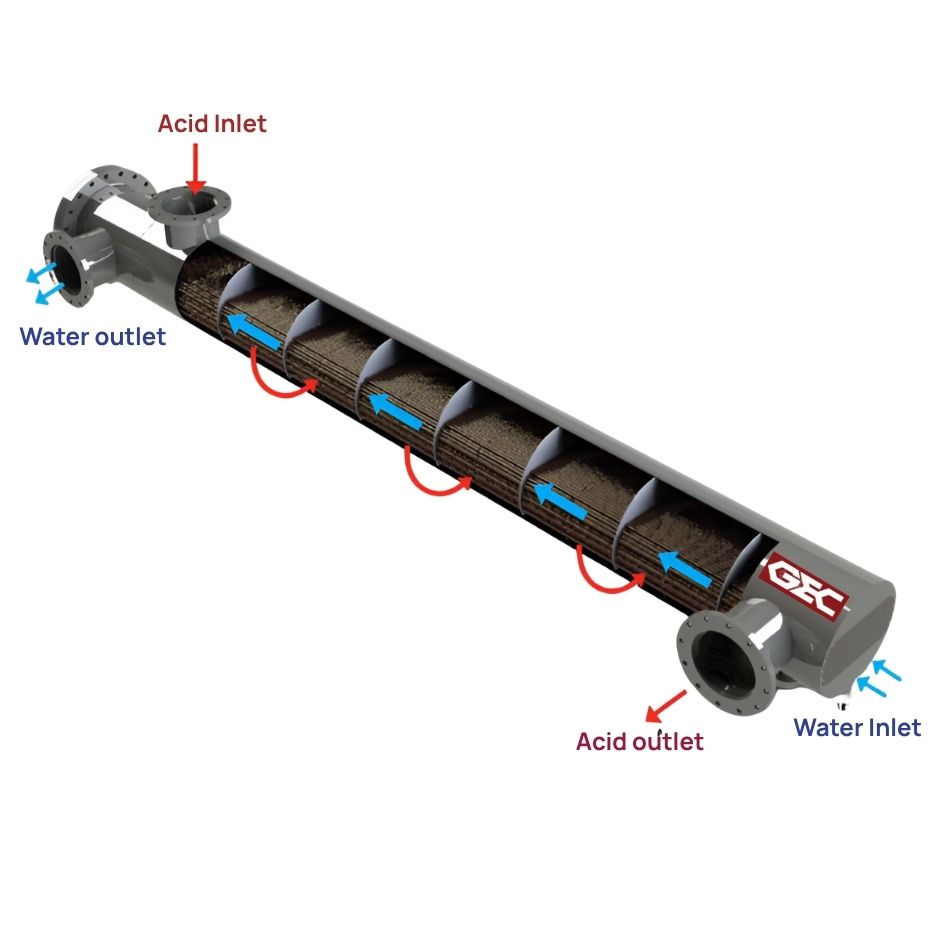
The Heat Exchanger works by passing the two fluids through separate channels, such as shells and tubes or plates, so that they do not come into direct contact with each other. The heat from the source fluid is transferred through the walls of the tubes and shells or plates to the target fluid, which is then heated up or cooled down.
There are different types of Heat Exchangers, such as Shell and Tube, Plate and Frame, and Spiral Heat Exchangers, all of which work on the same basic principle.

Acid Cooling from Acid Stream using Cooling Media*
*Illustrations are for representation purposes only.
Advantages of Shell and Tube Alloy Heat Exchangers
Low maintenance
- Requires minimal upkeep, eliminating the need for frequent maintenance.
- No expensive gaskets or electrical components need replacement.
- Periodic inspection involves simply removing end covers to check for fouling on the waterside.
Compact design with reduced piping (vertical installation) for Sulphuric Acid Heat Exchangers
- Can be installed vertically, reducing both space and piping requirements.
- Lowers capital and maintenance costs.
- Reduces overall pressure drop, saving energy and lowering operating expenses.
Leak-free design
- Only two connections for process fluid—one inlet and one outlet minimizing the risk of leakage.
- Features an all-welded construction with no gaskets or joints.
- Ensures a clean and safe operating area with no acid leakage.
Self-cleaning
- The waterside is self-cleaning when the correct water flow is maintained.
- Tubes have higher clearance compared to tight plate clearances, minimizing blockage risks.
Advanced materials of construction
- Built from advanced materials that significantly reduce corrosion in acidic environments, even at high temperatures.
Most thermally optimal design
- Superior thermal efficiency with higher resistance to erosion and temperature fluctuations compared to anodically protected coolers.
Longer life
- Low corrosion rate when concentration and temperature are properly maintained.
- More resilient to temporary operational upsets compared to anodically protected coolers, avoiding rapid corrosion under unexpected conditions.
- No risk of cooler damage due to electrical failures, as the base material itself is corrosion-resistant and requires no electrical power.
Advanced manufacturing and testing
- Fully automated manufacturing techniques using the latest generation welding processes.
- Most stringent Helium testing to ensure the highest quality.
What Our Customers Say
“In 1987, Galiakotwala Engineering Company (GEC) provided our first Shell and Tube Type Heat Exchanger with the assurance of an advanced, efficient design and manufactured with a low-corrosion alloy that would extend its lifespan. Even after 30+ years of trouble-free operation, the Heat Exchangers are still functioning effectively. We are pleased to report that GEC adhered to their commitments.”
Vice President Technology
Dharamsi Morarji, Roha