PHOSPHORIC ACID HEATER

Galiakotwala Engineering’s Alloy Phosphoric Acid Heater achieved 23% higher heat transfer efficiency and zero damaged or plugged tubes compared to the replaced Graphite Heater.

Phosphoric acidd heater 1

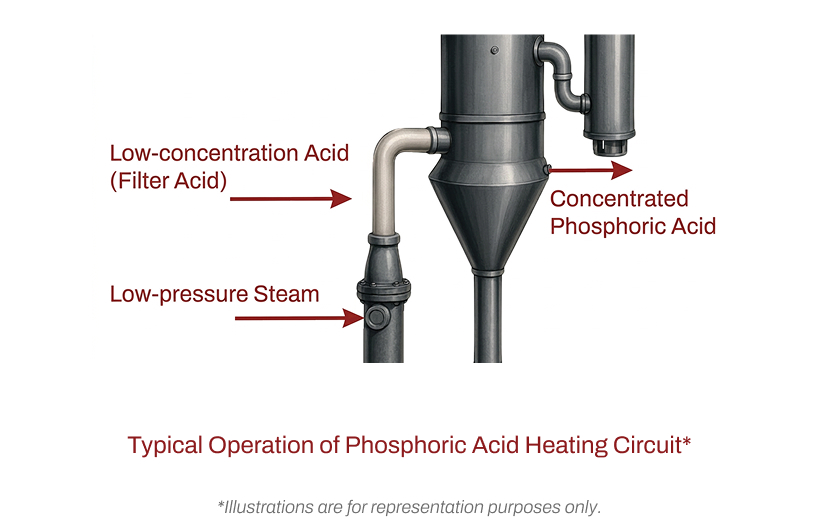
Phosphoric acid (H₃PO₄) is commonly concentrated from a dilute solution (~25-30%) to a higher concentration (~50-54%) in fertilizer and chemical plants. This is done using evaporation systems which includes a Shell and Tube Heat Exchanger.

How It Works

The Shell and Tube Heat Exchanger is used to heat the phosphoric acid, causing water to evaporate, thereby increasing acid concentration. Steam or hot water flows through the shell, while phosphoric acid flows in the tube (or vice versa depending on design). The heat causes partial evaporation of water content, leading to a higher concentration of phosphoric acid in the outlet stream.

The key selection criteria for a new Phosphoric Acid Heater is material selection and design.

Challenge: Phosphoric Acid Impurities

Corrosion

Due to presence of Halides, Sulphuric / Phosphoric / Hydrochloric Acid and many more corrosive compounds.

Erosion

Due to Gypsum crystals, rock particles, Silica, etc. in turbulence and deposit formation.

Conventional technology uses Graphite to solve these problems. However, Graphite lacks mechanical strength. This leads to tube damage and failure of the Heat Exchanger and subsequent cleaning. This can further lead to plant shutdown and downtime.

A more advanced solution is a Phosphoric Acid concentrator using a special Metallic Alloy.

Comparison Between Graphite and Metallic Alloy Tubes

PARAMETER

GRAPHITE TUBES

ALLOY TUBES

Mechanical Strength

Resistance to Erosion-Corrosion

Tube Cleaning

Tube Wall Thickness

External Tube Diameter

Heat Transfer Efficiency

Brittle, prone to fracture during cleaning

Lower resistance compared to metallic alloys

Needs extreme caution to avoid fractures

Thicker walls required to avoid fracture

Larger diameter required for similar mechanical stability

Higher due to better thermal conductivity

Offers higher mechanical strength and greater resistance to erosion

Better resistance

Can handle high pressure water washing

Thinner walls possible due to higher strength

Smaller diameter possible due to higher mechanical strength

Can maintain efficiency with redesign (more tubes, thinner walls)

Advantages of Metallic Phosphoric Acid Heater

Based on the above comparison the advantages of Alloy Heat Exchangers over Graphite Heat Exchangers are:

Longer Life

  • The life of Metallic heater is much longer than Graphite Heater.

Low Maintenance

  • The maintenance cost of the Metallic Heater is much lower than that of the Graphite Heater.

Lesser Breakdown

  • The efficiency of Graphite Heater goes down as damaged tubes have to be blocked, which affects production capacity.

Easier Tube Replacement

  • Metallic Tubes can be replaced maintaining production capacity.

Advanced Design

Galiakotwala Engineering uses sophisticated modelling software to ensure customized design for each and every Heat Exchanger to ensure it performs as required.

Detailed Design Approach*

Study of Combined Stresses*

*Illustrations are for representation purposes only.

What Our Customers Say

image 199
image 200
image 200
image 200
image 192
image 197
Frame 1000003858 (1)
Please enter official email address only
or Attach a document Attach
0/100 words