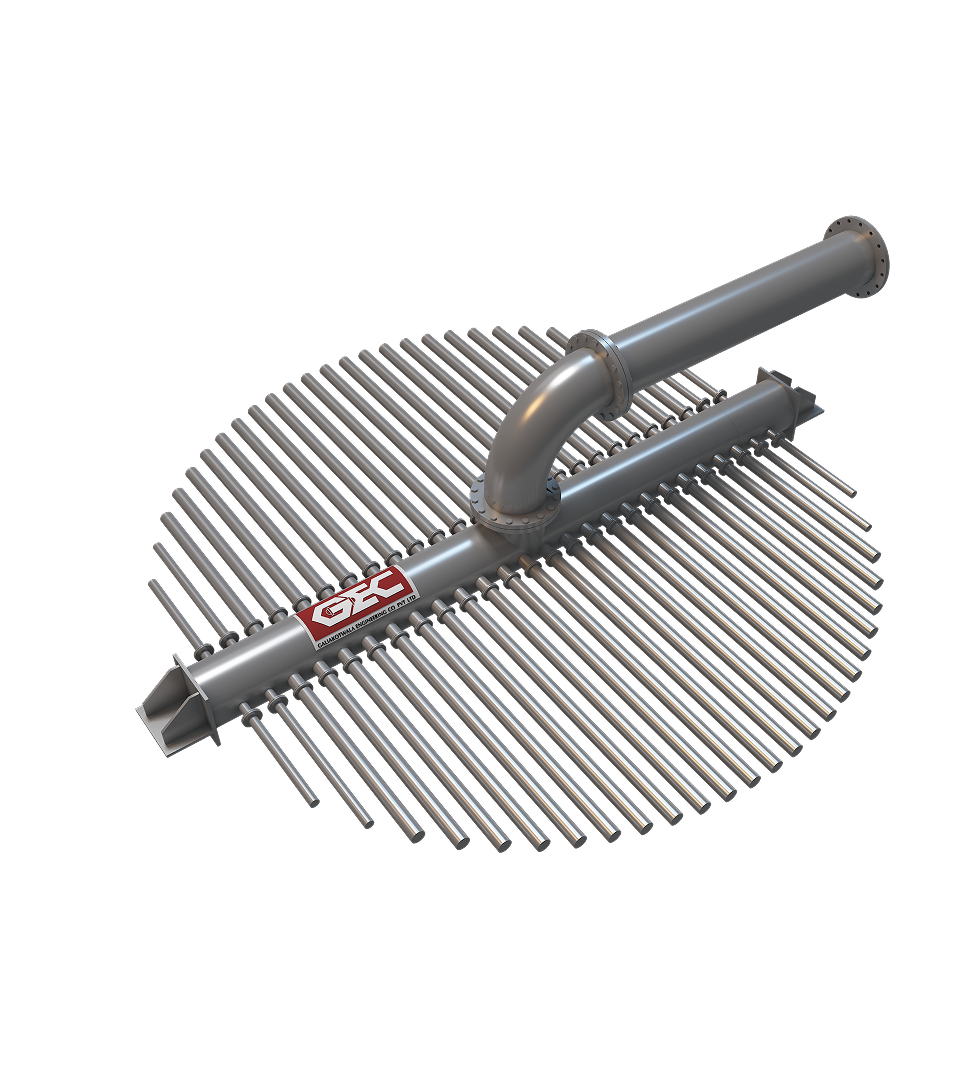
ALLOY ACID PIPE AND TROUGH DISTRIBUTORS
Galiakotwala Engineering has supplied 150+ Acid Distributors including one of the largest Acid Distributors in the world with a total diameter of 10 metres, which has been operating satisfactorily for many years.
Effective acid distribution systems are crucial in any tower to ensure the optimal operation of a Sulphuric Acid Plant. The Acid Distributor is a critical component of the drying and absorption tower system, as it evenly distributes acid over the packing. Complete contact and mixing of gas and acid are essential for the proper functioning of the drying and absorption towers.
Important Characteristics of a Good Acid Distribution System

Uniform acid distribution with full coverage of the tower area

Manufactured from corrosion resistant material

Proper acid flow rate to ensure complete irrigation of the packing without flooding

Easy to clean and maintain

Gentle distribution that avoids localised areas of high-velocity gas flow

Long service life

Simple Installation

Minimized mist generation

Resistant to plugging

Lowest possible life cycle cost
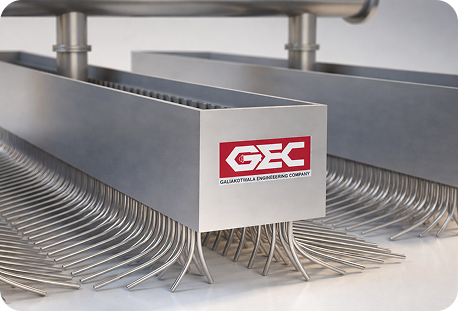
Trough Type Acid Distributor
Galiakotwala Engineering manufactures all types of distribution systems, including the Trough Type Distributor.
We have designed and manufactured distributors up to 8500mm in length, which have been operating successfully for over 10 years.
Trough Distributors are more sophisticated and are typically used in larger diameter towers. These distributors ensure precise and uniform acid flow across all sections of the tower, thereby enhancing absorption efficiency.
Trough Type Acid Distributor*
*Illustrations are for representation purposes only.
Advantages of Alloy Acid Distributors
Higher Efficiency
- The performance of Acid Distributors can be compared based on the number of acid distribution points.
- Conventional distributors limit the number of distribution points, whereas Alloy Distributors allow a significant increase in distribution points, typically 2 to 4 times more than conventional distributors.
Low Corrosion
- Conventional distributors usually exhibit high corrosion rates, often exceeding 100 mpy (2.5mm/yr).
- This leads to sulphate formation (sludge deposition) in the tower, causing plugging of tower packing, poor acid quality, gas channeling, frequent shutdowns, and maintenance issues, ultimately reducing the lifespan of downstream equipment.
- In contrast, Alloy Distributors exhibit corrosion rates of less than 2 mpy (0.05mm/yr), depending on the alloy used, eliminating the problem of sulphate formation and ensuring a clean distributor and tower operations.
Longer Life
- Alloy Distributors last 2–3 times longer than conventional ones due to low corrosion rates.
- Galiakotwala Engineering team recently inspected alloy units installed 20 years ago in a Sulphuric Acid Plant and found them in excellent condition.
Constant Performance
- In conventional distributors, corrosion enlarges orifices, reducing efficiency over time.
- Alloy Distributors resist corrosion, ensuring consistent performance throughout their lifespan.
Low Maintenance
- Alloy Distributors require virtually zero maintenance. Only periodic inspections of the branch pipes and main header are necessary to check for plugging.
No Stocking of Spare Parts
- Unlike conventional distributors, which are manufactured in blocks and require stocking of spare parts, Alloy Distributors are easily weldable using conventional welding techniques. This eliminates the need for spare part inventory.
Easy to Install and Clean
- Alloy Distributors are lightweight and easy to handle, making installation and maintenance a breeze.
- Each branch pipe can be easily disconnected from the main header for cleaning during shutdowns.
Reduce Load to Mist Eliminators
- Alloy Distributors are designed to distribute acid gently over the tower packing, reducing areas of high-velocity gas flow and minimizing mist generation, pressure drop, and load on Mist Eliminators.
What Our Customers Say
“We were continuously facing excess mist generation and moisture carryover problems in FAT and DT with the conventional distributors. Galiakotwala Engineering Company (GEC) replaced conventional distributors with Alloy Distributors in 2004. Since then, there is no change in the thickness and deformation of hole sizes of the branch pipes of the distributor. We appreciate the quality of work and the materials used by GEC even after 18 years of operation.”
Deputy General Manager (Mechanical),
Paradeep Phosphates Limited